
Cookie CodersFTC Team 39092

Engineering // 2026-2027 BIOBUZZ

Think. Build.
Bot.

Engineering is where imagination meets evidence. We study the field, model the forces, integrate the robot as a system, and test one meaningful question at a time.

01Born to Build

Industrial
design.

Every experiment follows the same learning loop: turn the game problem into a test, capture evidence, find the bottleneck, improve one variable, and make the result repeatable.

02The learning loop

One loop.
Run it again.

  1. Design

    Translate a game requirement into a mechanism, geometry, strategy, or model.

  2. Measure

    Capture timing, accuracy, reliability, failure modes, and test conditions.

  3. Analyze

    Identify the constraint, contradiction, or assumption the evidence no longer supports.

  4. Improve

    Change one meaningful variable and test the full system again.

  5. Control

    Use feedback, documentation, training, and safe limits to make progress repeatable.

03How we engineer

Two pillars
under every build.

Engineering pillar 01

Safety is a design requirement.

Safe engineering begins before a mechanism moves. We design around secure batteries, protected wiring, stable structures, guarded pinch points, deliberate test boundaries, inspection readiness, and reliable stop behavior.

  • Follow the current Competition Manual and official safety guidance
  • Identify stored energy, heat, sharp edges, pinch points, and failure paths
  • Use bounded tests, clear roles, protective equipment, and stop criteria
  • Never trade student safety for speed, points, or schedule
Engineering pillar 02

Responsibility earns trust.

Responsible engineers make their assumptions visible, report results honestly, protect people and equipment, and leave systems understandable enough for another student to inspect, operate, and improve.

  • Separate simulation predictions from measured physical performance
  • Document decisions, test conditions, failures, and unresolved risks
  • Design for maintenance, recovery, and the people using the robot
  • Make only claims that current evidence can support
04Current engineering focus

One robot.
One understandable system.

Our goal is an integrated robot whose structure, mechanisms, wiring, controls, maintenance access, and match strategy support one another.

Field and geometry

Study HIVE access, FLOWER interaction, travel paths, sightlines, robot bounds, and the space required to collect and score.

Mechanism integration

Evaluate packaging, service access, protected wiring, weight, driver visibility, and interaction between subsystems.

Reliability first

Track jams, missed detections, bounce-outs, reset behavior, recovery time, and the conditions surrounding every test.

05Digital Twins // Physics

See the invisible.
Understand the possible.

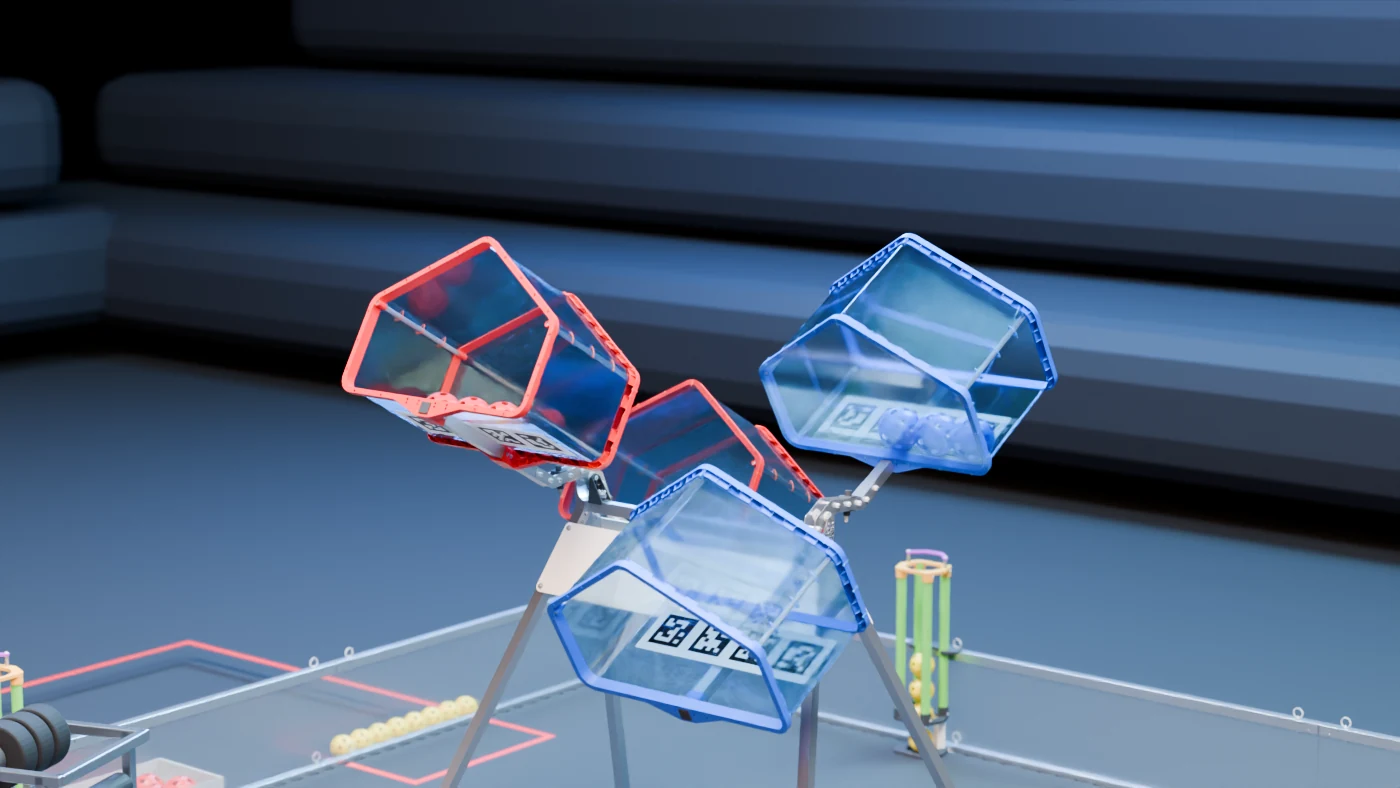
Digital Twins help students explore how mass, friction, torque, launch velocity, geometry, and timing change the system—then compare those predictions with the physical field.

  1. Drive

    Motor curves, gearing, traction, mass, and inertia

  2. Launch

    Velocity, angle, compression, spin, and bounce

  3. Field

    Geometry, collision, HIVE state, travel, and congestion

  4. Calibration

    Prediction error, physical measurement, and model revision

Cinematic BIOBUZZ HIVE used to study geometry and physical behavior
07Growth Mindset

A growing toolset
for growing ambition.

Harder problems invite new skills and better instruments—from CAD and fabrication references to physics simulation, source-backed team knowledge, and deployment tools.